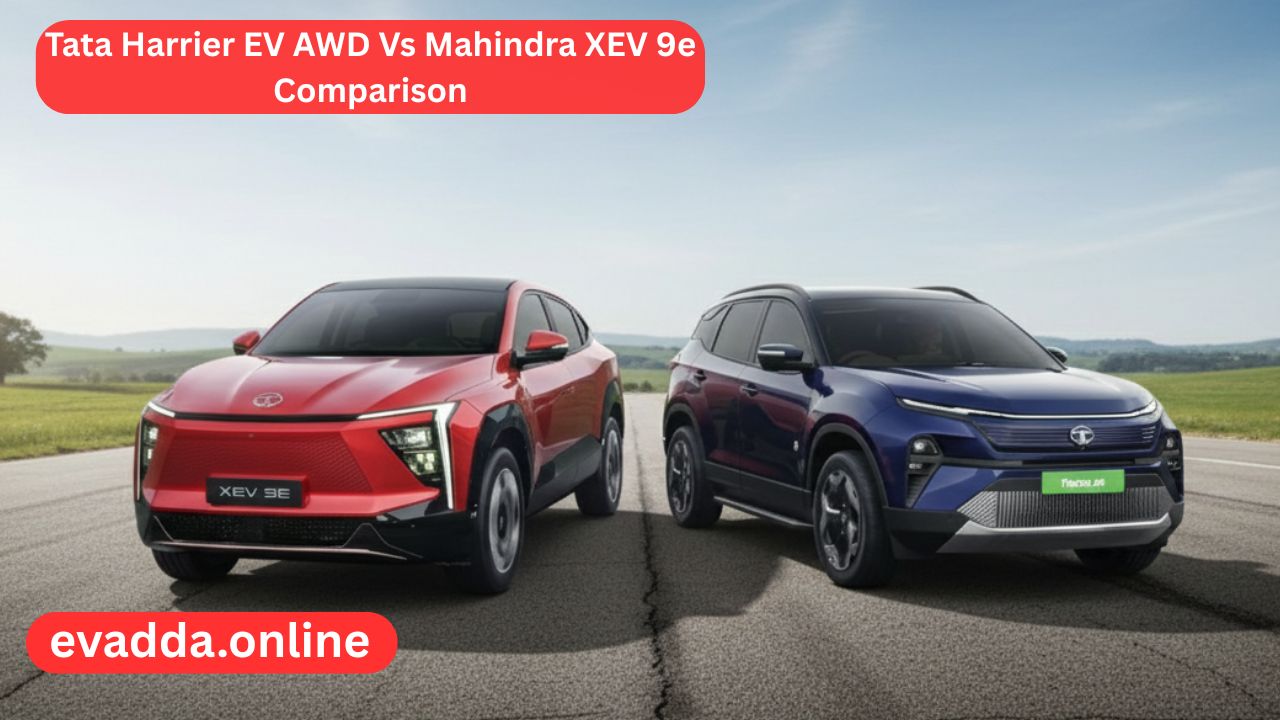
Electric SUVs are quickly becoming the first choice for Indian buyers who want performance, comfort, and lower running costs in one package. At the premium end of this shift are two homegrown rivals that are being cross-shopped heavily in 2025, Tata Harrier EV AWD Vs Mahindra XEV 9e Comparison.
Both are five-seat flagship electric SUVs, priced close to each other, and promise strong performance with modern tech. On paper, they look evenly matched. But numbers alone don’t tell the full story. What really matters is how these EVs perform in the real world, in acceleration, braking, range, comfort, and everyday usability.
Table of Contents
Tata Harrier EV AWD Vs Mahindra XEV 9e Comparison Design and Body Style
The first big difference you notice is their approach to design.
The Mahindra XEV 9e is a born-electric coupe-SUV. It looks sleek and futuristic, with flush door handles, a sloping roofline, and a tech-forward stance. This design helps it stand out, especially for buyers who prefer something modern and premium-looking.
The Tata Harrier EV, on the other hand, sticks to a more traditional SUV shape. It looks familiar, muscular, and upright. very similar to the ICE Harrier, with EV-specific tweaks. This design offers better headroom and a more commanding road presence, especially for family use.
Verdict
XEV 9e looks more futuristic, while Harrier EV feels more practical and SUV-like.
Harrier EV AWD vs XEV 9e Performance Power and Acceleration
This is where the Harrier EV AWD starts making a strong case.
Powertrain Comparison
- Harrier EV AWD: Dual-motor, AWD setup
- XEV 9e Pack Three: Single motor, RWD
Thanks to its dual motors, the Harrier EV produces more power and significantly more torque. Even though it’s heavier, the AWD system helps put that power down cleanly.
Real-World Acceleration
In real-world tests
- Harrier EV reaches 0–100 km/h quicker
- It pulls ahead early and maintains the lead through higher speeds
- XEV 9e feels fast but slightly more relaxed in outright acceleration
The Mahindra XEV 9e, however, has a higher top speed, which may appeal to highway-focused drivers, even though most people rarely use that advantage.
Verdict
If quick launches and strong mid-range pull matter to you, the Harrier EV AWD feels more aggressive and confident.
Tata Harrier EV vs Mahindra XEV 9e: Rolling Acceleration Comparison
Rolling acceleration is what you feel during overtakes.
- Harrier EV AWD is quicker in
- 20–80 km/h
- 40–100 km/h
- The power delivery is linear and controlled
- AWD improves grip during sudden acceleration
The XEV 9e feels smooth and effortless but falls slightly behind when pushed hard.
Verdict
For real-world overtakes, the Harrier EV AWD has a small but noticeable edge.
Braking and Regenerative Performance Comparison
Despite being heavier, the Harrier EV stops quicker in emergency braking tests.
- Shorter braking distance
- Faster braking time
- Stronger regenerative braking levels
The XEV 9e, however, offers single-pedal driving, which many city users prefer. It allows the car to slow down significantly without touching the brake pedal.
Verdict
Harrier EV wins on braking performance, XEV 9e wins on regen convenience.
Range and Charging Harrier EV AWD vs XEV 9e
Range anxiety is still a concern for many buyers, and here the difference is small.
Claimed Range
- XEV 9e: Slightly higher claimed range
- Harrier EV: Marginally lower but still competitive
In real-world usage, the difference is unlikely to matter much for daily driving.
Charging
- XEV 9e supports faster DC charging
- AC charging time is also slightly shorter
- Harrier EV is a bit slower but still practical for home charging
Verdict
XEV 9e has a minor advantage in charging speed and efficiency.
Interior Space, Seating and Practicality
This is where buyer priorities really matter.
Front Seats
- Comfortable in both SUVs
- XEV 9e offers slightly more knee room
- Harrier EV has better headroom
Rear Seats
- XEV 9e clearly wins here
- Reclining backrest
- Better under-thigh support
- More foot space
- Harrier EV’s rear seat is upright and less flexible
Boot and Storage
- XEV 9e offers a larger boot and a very usable frunk
- Harrier EV’s boot is taller but has a high loading lip
- Frunk in Harrier EV is smaller and mostly for cables
Verdict
For family comfort and storage, the Mahindra XEV 9e feels more practical.
Features and Technology Comparison
The XEV 9e feels more tech-heavy
- Triple-screen dashboard
- Passenger display
- Wireless Android Auto & CarPlay
- Rear entertainment screens (on higher trims)
- Heads-up display with AR
The Harrier EV focuses more on driving and utility
- Larger central QLED screen
- Digital IRVM with recording
- Terrain modes and off-road assist
- V2L and V2V charging
Verdict
XEV 9e is more tech-oriented, Harrier EV is more function-focused.
Safety and Driving Confidence
Both SUVs offer strong safety packages, but the Harrier EV AWD stands out with:
- AWD traction
- Terrain modes
- Better off-road confidence
- Transparent underbody camera
The XEV 9e also offers ADAS, but many features are trim-dependent.
Verdict
For challenging roads and varied conditions, Harrier EV feels more confidence-inspiring.
Pricing and Value for Money
- Harrier EV starts cheaper and offers AWD at a lower price
- XEV 9e costs more but offers better cabin tech and comfort
Introductory pricing gives the Harrier EV a strong value advantage right now.
Wrap-Up
If your priority is performance, AWD capability, braking confidence, and value, the Tata Harrier EV AWD makes more sense.
If you care more about interior comfort, futuristic design, tech features, and charging speed, the Mahindra XEV 9e is the better daily companion.
Both SUVs are strong in their own ways, and the right choice depends on whether you value driving strength or cabin experience more.
FAQs
Q1. Which EV is faster, Harrier EV AWD or XEV 9e?
The Tata Harrier EV AWD is quicker in real-world acceleration tests.
Q2. Does Mahindra XEV 9e offer better range?
Yes, it has a slightly higher claimed range, though real-world difference is minimal.
Q3. Which EV is better for family comfort?
The Mahindra XEV 9e offers better rear seat comfort and storage.
Q4. Is AWD useful in the Harrier EV?
Yes, it improves traction, acceleration, and off-road capability.
Q5. Which electric SUV offers better value in 2025?
At current pricing, the Tata Harrier EV AWD offers stronger value for money.
Read More